The Mind-Body Problem
http://www.philosophy-index.com/philosophy/mind/mind-body.php
The Mind-Body Problem
The mind-body problem is an ongoing problem in the philosophy of mind and in metaphysics, concerning the nature of the relationship between the mind, or conciousness, and the physical world.
The mind-body problems asks a number of questions: Are the mind and body separate substances or elements of the same substance? What is their relationship to each other? What is conciousness? And how can conciousness arise out of ordinary matter?
There are a number of responses to the mind-body problem, though none have universal acceptance. A number of these positions are outlined below:
Dualism, the position that the mind is essentially not physical, and exists separately from the body. Dualism comes in various forms:
Interactionism, which states that the mind and body have causal interaction.
Occasionalism, which states the apparently causal links between mind and body are actually divine intervention.
Parallelism, which states that the apparent causal link between mind and body is an illusion, and that mind and body run parallel to one another.
Property dualism, which holds that the mind emerges from the body, and obtains status as something separate
Monism, the position that the mind and body are not fundamentally separate. There are several types of mind-body monism:
Physicalism, including most commonly-held positions today, which asserts that the mind may be reduced to the physical processes of the brain.
Behaviourism, which holds that talk about mental states can be reduced to talk about behaviours.
Functionalism, which states that mental states are caused by behaviours, senses and other mental states.
Type physicalism, which argues that mental states are equivalent to brain states.
Idealism, which claims that the mind is all that exists.
Phenomenalism, which reduces the physical world to perceptions which exist within the mind alone.
The mind-body problem was brought up in antiquity, and can be seen in the works of Plato, though its modern formulation can be credited to René Descartes, who also presents a dualist response.
Mind-Body Dualism
Dualism is a position in philosophy of mind that states that, in some fundamental or important way, the mind exists as something separate from the brain, or body. Most forms of mind-body dualism claim that the mind is not a physical thing.
Plato was an early dualist. The Phaedo asserts that the soul exists separately from the body, in the realm of the forms, and temporarily inhabits the body during the course of mortal life, only to be released and rejoin the forms upon death.
René Descartes remains one of the most important dualists from a historical context. In addition to his modern framing of the mind-body problem, Descartes presents a classic argument for dualism. His Meditations on First Philosophy begins with a process of extreme doubt, in which Descartes becomes skeptical of all of his beliefs, such as his sense perception of the world. He concludes, however, that he cannot doubt his own existence — for to doubt is to think, and to think requires that he be a thinking thing. From this he formulates his famous argument: Je pense donc je suis, or Cogito, ergo sum, which both amount to “I think, therefore I am”.
As Descartes continues his meditations, he builds up a number of ways in which the mind is different than the body. Descartes concludes that the mind is a sort of substance separate from the physical body. Descartes' dualism, known as Cartesian Dualism also states that mind and body causally interact, making his view a form of interactionism.
return
Interactionism Interactionism is a dualist position in the philosophy of mind which argues that (1) mind and body are separate, but that (2) there is causal interaction between the two.
return
Cartesian dualism, the position of René Descartes is the most famous example of interactionism.
Descartes was an interactionist, and a substance dualist who believed that the mind and body had a causal link. However, a problem arises when interactionalism and substance dualism are coupled — namely, how can an immaterial entity with no extension in the physical world cause changes in a physical body, and how can a physical body cause changes, moods or feelings in a non-physical mind?
Descartes at one point suggested that the pineal gland in the brain may be the link between the soul and the body, but later abandoned the idea admitting that he did not have an answer to the problem. Other followers of Descartes' tradition later suggested that the causal link between mind and body was occasion for divine intervention — that the apparent cause and effect were not direct, but that the hand of God was the actual cause of action in the physical world.
return
Occasionalism Occasionalism is a theory in philosophy that causality is essentially an illusion—that substances are created by God and that what appears to be cause and effect between substances is merely an instance of God directly causing certain actions in the world.
With respect to philosophy of mind, occasionalism is presented as an answer to one of the problems with the dualism of René Descartes. Descartes' theory is an interactionist one—that is, it describes mind and body as being causally linked. However, since Descartes asserts that the mind and body are separate entities, one being of physical substance and the other being of mental substance (and hence not being extended in space), an obvious question arises: how can the mind cause changes in the body, and how can changes in the body affect the mind?
Descartes never presented a good response to this question, but philosophers such as Nicolas Malebranche offered occasionalism as an answer: that the mind and body were connected by God's will, and that God directly caused changes in the physical world to correspond with the mind.
return
Parallelism Parallelism, or psychophysical parallelism (meaning that mind and body are parallel) is a form of dualism which denies any interaction between mind and body.
Parallelism is a difficult position to hold, since it does little to account for the fact that the brain and mind seem to regularly interact, and that changes in one appear to affect the other. If the two are separate substances in a dualist view, then the idea that there is no causality between them, yet obvious changes in both simultaneously, seems counter-intuitive. For this reason it is not a commmonly held belief, but merely a presentation of the third possibility, the others being two-way interaction (as in interactionism) and one-way interaction, as in most forms of physicalism.
Although Leibniz was a monist, believing that only one true substance exists, he presented a form of parallelism in his theory of mind. Leibniz states that although they are of the same substance, the distinction between mind and body is a useful one for the purposes of understanding and explanation. He held that they are not causally related, but that they follow the same path which has been previously arranged by God. Leibniz's theory is known as pre-established harmony.
return
Property dualism is a variety of dualism in the philosophy of mind which argues that mind and body exist as ontologically distinct properties of a single, physical substance.
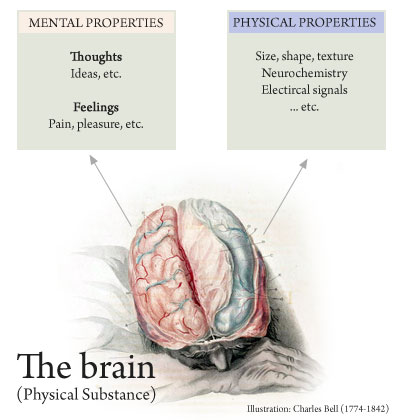
Monism In the philosophy of mind, monism is an answer to the mind-body problem, which holds that there is only one substance that exists, be it mind or body. The two main versions of the monist response to philosophy of mind are physicalism, which holds that only the body truly exists, and idealism, which argues that only the mind truly exists. The alternatives to monism are the various versions of dualism.
return
Physicalism, including most commonly-held positions today, which asserts that the mind may be reduced to the physical processes of the brain. Behaviourism, which holds that talk about mental states can be reduced to talk about behaviours. Functionalism, which states that mental states are caused by behaviours, senses and other mental states. Type physicalism, which argues that mental states are equivalent to brain states. Idealism, which claims that the mind is all that exists. Phenomenalism, which reduces the physical world to perceptions which exist within the mind alone.
return
Behaviourism Behaviourism (or behaviorism in American English), is a position in philosophy of mind and psychology which asserts that speak of mental states may be reduced to speak of behaviours. In other words, to the behaviourist, thinking and feeling are essentially behaviours.
For the behaviourist, the phrase “Jane is thirsty” means nothing more than “Jane is likely to drink” (or try to drink).
Behaviourism generally holds that since the mental states of other individuals are inaccessible, they have no business in either ontology or in general speak. Strong behaviourists go a step further to assert that the mind does not exist at all, and is always reducable to behaviour. Opponents of behaviourism argue that this is counter-intuitive, since each of us has access to one case in which this does not seem to be true, namely our own mind.
return
Functionalism Functionalism is a position in philosophy of mind which argues that mental states consist essentially of the role that they play in the functioning of the organism. Functionalism is neither physicalist nor dualist perspective, since it does not describe the mind and body as separate substances, nor does it reduce the mental to its physical components.
Functionalism describes the mind as a layer of abstraction, functioning between the physical body and its output, that is, behaviour. This functional layer of mind recieves input from the body's senses and from other mental states within itself, and then prepares and executes output by means of behaviour. This seems like a computer program quite intentionally — functionalism suggests that the mind forms a sort of biological computer, taking input and processing it much like a sophisticated computer.
As computer software is an abstraction of the electrical and magnetic signals within a computer's structure, so too is the mind an abstraction of the physical process within the brain. And just as sophisticated software becomes incomprehensible if we reduce it to its flow of electrons through circutry, it is not useful to reduce any mental state, or consider it identical, to its corresponding physical activity. (Although the computer analogy may be different in that data seems to not be lost when we examine the electrons or bits at their basic level, they are unintelligible without the higher levels which are meant to decode them.)
The analogy of the computer is useful for functionalism because it shows how the mind is more complex than the functionality of other organs, such as the heart, which have a simpler purpose, such as pumping blood through the circulatory system.
return
Type Identity Theory Type identity thoery, or type physicalism is the theory that brain activity and corresponding mental processes are type-identical.
The term type in this version of identity theory is meant to signify a difference between type and token, in which type is a category and token is an instance of a member of that category. For instance, the phrase “bigger and bigger and bigger” contains two types of words (the types being “bigger” and “and”) and five tokens (three tokens of the type “bigger” and two tokens of the type “and”).
So, activity in a specific type of tissue or area of the brain may correspond with pleasure, making pleasure and that brain activity type-identical.
return
Token Physicalism / Token Identity
Token identity from type identity in that the relationship between a physical and mental event is more specific to the event. A specific token of a physical occurance in the brain corresponds with a specific token of a mental activity. Token identity theory more broadly states that mental and physical processes generally refer to the same thing, though they need not be neccessarily of a specific type on either side. Token physicalism is, in essence, the same as property dualism which holds that mental properties of the brain (mental tokens) correspond with physical properties of the brain (physical tokens) — both of which are analogous to each other and refer to the same physical object, but which differ ontologically in that mental processes are of a different quality than their physical counterparts.
return
Phenomenalism in Philosophy of Mind Phenomenalism is the position that the physical world exists only as sensory data in the perception of minds, and not as a substance or a thing in itself. Phenomenalism is a form of idealism.
Weaker phenomenalism states only that the sense perception can be known to exist, and that it is either meaningless or useless to talk of objects outside of perception. Stronger versions deny that anything exists outside of sense perception.
As a position, Phenomenalism may have began with the immaterialism of Charles Berkeley, who argued that we cannot know objects outside of our perception of them. Berkeley claimed that objects maintain their existence when no person is perceiving them because God is constantly perceiving all objects.
Some interperetations of quantum mechanics seem to be favour phenomenalism. Quantum mechanics states that particles have a fixed velocity and position, but that the precisce observation of one of these properties makes the other unknown. It also suggests that particles do not assume a specific velocity or position until they are observed. This seems counter-intuitive, but this strange behaviour of matter particles would correspond with phenomenalism, since things would not exist in a definite form until observed. Physicists, of course, have different interperetations (and some definite rejections) of some of the claims of quantum mechanics, so this may not prove to be adequate support for phenomenalism.
The Mind-Body Problem
The mind-body problem is an ongoing problem in the philosophy of mind and in metaphysics, concerning the nature of the relationship between the mind, or conciousness, and the physical world.
The mind-body problems asks a number of questions: Are the mind and body separate substances or elements of the same substance? What is their relationship to each other? What is conciousness? And how can conciousness arise out of ordinary matter?
There are a number of responses to the mind-body problem, though none have universal acceptance. A number of these positions are outlined below:
Dualism, the position that the mind is essentially not physical, and exists separately from the body. Dualism comes in various forms:
Interactionism, which states that the mind and body have causal interaction.
Occasionalism, which states the apparently causal links between mind and body are actually divine intervention.
Parallelism, which states that the apparent causal link between mind and body is an illusion, and that mind and body run parallel to one another.
Property dualism, which holds that the mind emerges from the body, and obtains status as something separate
Monism, the position that the mind and body are not fundamentally separate. There are several types of mind-body monism:
Physicalism, including most commonly-held positions today, which asserts that the mind may be reduced to the physical processes of the brain.
Behaviourism, which holds that talk about mental states can be reduced to talk about behaviours.
Functionalism, which states that mental states are caused by behaviours, senses and other mental states.
Type physicalism, which argues that mental states are equivalent to brain states.
Idealism, which claims that the mind is all that exists.
Phenomenalism, which reduces the physical world to perceptions which exist within the mind alone.
The mind-body problem was brought up in antiquity, and can be seen in the works of Plato, though its modern formulation can be credited to René Descartes, who also presents a dualist response.
Mind-Body Dualism
Dualism is a position in philosophy of mind that states that, in some fundamental or important way, the mind exists as something separate from the brain, or body. Most forms of mind-body dualism claim that the mind is not a physical thing.
Plato was an early dualist. The Phaedo asserts that the soul exists separately from the body, in the realm of the forms, and temporarily inhabits the body during the course of mortal life, only to be released and rejoin the forms upon death.
René Descartes remains one of the most important dualists from a historical context. In addition to his modern framing of the mind-body problem, Descartes presents a classic argument for dualism. His Meditations on First Philosophy begins with a process of extreme doubt, in which Descartes becomes skeptical of all of his beliefs, such as his sense perception of the world. He concludes, however, that he cannot doubt his own existence — for to doubt is to think, and to think requires that he be a thinking thing. From this he formulates his famous argument: Je pense donc je suis, or Cogito, ergo sum, which both amount to “I think, therefore I am”.
As Descartes continues his meditations, he builds up a number of ways in which the mind is different than the body. Descartes concludes that the mind is a sort of substance separate from the physical body. Descartes' dualism, known as Cartesian Dualism also states that mind and body causally interact, making his view a form of interactionism.
return
Interactionism Interactionism is a dualist position in the philosophy of mind which argues that (1) mind and body are separate, but that (2) there is causal interaction between the two.
return
Cartesian dualism, the position of René Descartes is the most famous example of interactionism.
Descartes was an interactionist, and a substance dualist who believed that the mind and body had a causal link. However, a problem arises when interactionalism and substance dualism are coupled — namely, how can an immaterial entity with no extension in the physical world cause changes in a physical body, and how can a physical body cause changes, moods or feelings in a non-physical mind?
Descartes at one point suggested that the pineal gland in the brain may be the link between the soul and the body, but later abandoned the idea admitting that he did not have an answer to the problem. Other followers of Descartes' tradition later suggested that the causal link between mind and body was occasion for divine intervention — that the apparent cause and effect were not direct, but that the hand of God was the actual cause of action in the physical world.
return
Occasionalism Occasionalism is a theory in philosophy that causality is essentially an illusion—that substances are created by God and that what appears to be cause and effect between substances is merely an instance of God directly causing certain actions in the world.
With respect to philosophy of mind, occasionalism is presented as an answer to one of the problems with the dualism of René Descartes. Descartes' theory is an interactionist one—that is, it describes mind and body as being causally linked. However, since Descartes asserts that the mind and body are separate entities, one being of physical substance and the other being of mental substance (and hence not being extended in space), an obvious question arises: how can the mind cause changes in the body, and how can changes in the body affect the mind?
Descartes never presented a good response to this question, but philosophers such as Nicolas Malebranche offered occasionalism as an answer: that the mind and body were connected by God's will, and that God directly caused changes in the physical world to correspond with the mind.
return
Parallelism Parallelism, or psychophysical parallelism (meaning that mind and body are parallel) is a form of dualism which denies any interaction between mind and body.
Parallelism is a difficult position to hold, since it does little to account for the fact that the brain and mind seem to regularly interact, and that changes in one appear to affect the other. If the two are separate substances in a dualist view, then the idea that there is no causality between them, yet obvious changes in both simultaneously, seems counter-intuitive. For this reason it is not a commmonly held belief, but merely a presentation of the third possibility, the others being two-way interaction (as in interactionism) and one-way interaction, as in most forms of physicalism.
Although Leibniz was a monist, believing that only one true substance exists, he presented a form of parallelism in his theory of mind. Leibniz states that although they are of the same substance, the distinction between mind and body is a useful one for the purposes of understanding and explanation. He held that they are not causally related, but that they follow the same path which has been previously arranged by God. Leibniz's theory is known as pre-established harmony.
return
Property dualism is a variety of dualism in the philosophy of mind which argues that mind and body exist as ontologically distinct properties of a single, physical substance.
Monism In the philosophy of mind, monism is an answer to the mind-body problem, which holds that there is only one substance that exists, be it mind or body. The two main versions of the monist response to philosophy of mind are physicalism, which holds that only the body truly exists, and idealism, which argues that only the mind truly exists. The alternatives to monism are the various versions of dualism.
return
Physicalism, including most commonly-held positions today, which asserts that the mind may be reduced to the physical processes of the brain. Behaviourism, which holds that talk about mental states can be reduced to talk about behaviours. Functionalism, which states that mental states are caused by behaviours, senses and other mental states. Type physicalism, which argues that mental states are equivalent to brain states. Idealism, which claims that the mind is all that exists. Phenomenalism, which reduces the physical world to perceptions which exist within the mind alone.
return
Behaviourism Behaviourism (or behaviorism in American English), is a position in philosophy of mind and psychology which asserts that speak of mental states may be reduced to speak of behaviours. In other words, to the behaviourist, thinking and feeling are essentially behaviours.
For the behaviourist, the phrase “Jane is thirsty” means nothing more than “Jane is likely to drink” (or try to drink).
Behaviourism generally holds that since the mental states of other individuals are inaccessible, they have no business in either ontology or in general speak. Strong behaviourists go a step further to assert that the mind does not exist at all, and is always reducable to behaviour. Opponents of behaviourism argue that this is counter-intuitive, since each of us has access to one case in which this does not seem to be true, namely our own mind.
return
Functionalism Functionalism is a position in philosophy of mind which argues that mental states consist essentially of the role that they play in the functioning of the organism. Functionalism is neither physicalist nor dualist perspective, since it does not describe the mind and body as separate substances, nor does it reduce the mental to its physical components.
Functionalism describes the mind as a layer of abstraction, functioning between the physical body and its output, that is, behaviour. This functional layer of mind recieves input from the body's senses and from other mental states within itself, and then prepares and executes output by means of behaviour. This seems like a computer program quite intentionally — functionalism suggests that the mind forms a sort of biological computer, taking input and processing it much like a sophisticated computer.
As computer software is an abstraction of the electrical and magnetic signals within a computer's structure, so too is the mind an abstraction of the physical process within the brain. And just as sophisticated software becomes incomprehensible if we reduce it to its flow of electrons through circutry, it is not useful to reduce any mental state, or consider it identical, to its corresponding physical activity. (Although the computer analogy may be different in that data seems to not be lost when we examine the electrons or bits at their basic level, they are unintelligible without the higher levels which are meant to decode them.)
The analogy of the computer is useful for functionalism because it shows how the mind is more complex than the functionality of other organs, such as the heart, which have a simpler purpose, such as pumping blood through the circulatory system.
return
Type Identity Theory Type identity thoery, or type physicalism is the theory that brain activity and corresponding mental processes are type-identical.
The term type in this version of identity theory is meant to signify a difference between type and token, in which type is a category and token is an instance of a member of that category. For instance, the phrase “bigger and bigger and bigger” contains two types of words (the types being “bigger” and “and”) and five tokens (three tokens of the type “bigger” and two tokens of the type “and”).
So, activity in a specific type of tissue or area of the brain may correspond with pleasure, making pleasure and that brain activity type-identical.
return
Token Physicalism / Token Identity
Token identity from type identity in that the relationship between a physical and mental event is more specific to the event. A specific token of a physical occurance in the brain corresponds with a specific token of a mental activity. Token identity theory more broadly states that mental and physical processes generally refer to the same thing, though they need not be neccessarily of a specific type on either side. Token physicalism is, in essence, the same as property dualism which holds that mental properties of the brain (mental tokens) correspond with physical properties of the brain (physical tokens) — both of which are analogous to each other and refer to the same physical object, but which differ ontologically in that mental processes are of a different quality than their physical counterparts.
return
Phenomenalism in Philosophy of Mind Phenomenalism is the position that the physical world exists only as sensory data in the perception of minds, and not as a substance or a thing in itself. Phenomenalism is a form of idealism.
Weaker phenomenalism states only that the sense perception can be known to exist, and that it is either meaningless or useless to talk of objects outside of perception. Stronger versions deny that anything exists outside of sense perception.
As a position, Phenomenalism may have began with the immaterialism of Charles Berkeley, who argued that we cannot know objects outside of our perception of them. Berkeley claimed that objects maintain their existence when no person is perceiving them because God is constantly perceiving all objects.
Some interperetations of quantum mechanics seem to be favour phenomenalism. Quantum mechanics states that particles have a fixed velocity and position, but that the precisce observation of one of these properties makes the other unknown. It also suggests that particles do not assume a specific velocity or position until they are observed. This seems counter-intuitive, but this strange behaviour of matter particles would correspond with phenomenalism, since things would not exist in a definite form until observed. Physicists, of course, have different interperetations (and some definite rejections) of some of the claims of quantum mechanics, so this may not prove to be adequate support for phenomenalism.


Commentaires
Enregistrer un commentaire